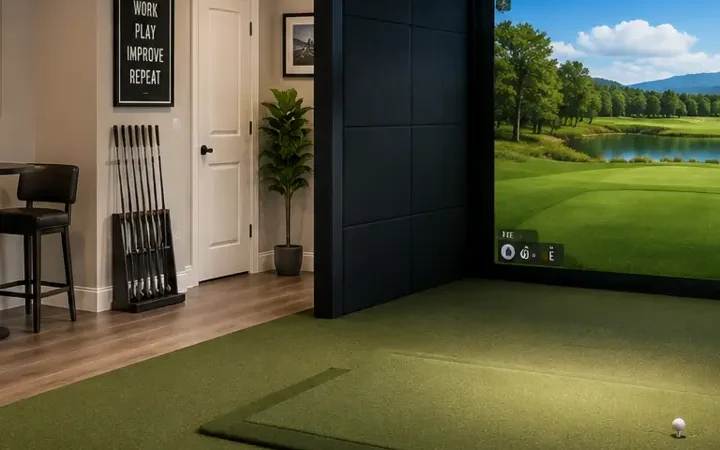
Golf no longer has to stop when the sun goes down, bad weather arrives, or the course is too crowded. Home indoor golf simulators have transformed the way golfers practice and play, bringing realistic courses, detailed swing information, and year-round entertainment into the home.
Once reserved primarily for professional training facilities and commercial golf centers, golf simulator technology is now available in a wide range of home-friendly configurations. A home golf simulator can be installed in a dedicated golf room, garage, basement, spare room, or multipurpose entertainment space.
Whether you want to improve your swing, play virtual rounds with friends, or create a complete golf man cave, a successful setup begins with four essential categories: golf simulators and launch monitors, hitting mats and nets, putting greens and training aids, and golf man cave gear.
Golf Simulators and Launch Monitors
The technology behind an indoor golf simulator begins with the launch monitor. This device measures what happens when the club strikes the ball and sends the information to simulator software.
Depending on the system, a golf launch monitor may track ball speed, clubhead speed, launch angle, spin rate, carry distance, shot direction, and other performance data. More advanced systems can provide detailed club-path and impact information for golfers who want deeper swing analysis.
Launch monitors use different tracking technologies. Camera-based systems capture images of the club and ball around the moment of impact. Radar-based systems track the ball’s movement after it is struck. Some units are placed beside the ball, while others sit behind the hitting area or are permanently mounted overhead.
The best choice depends on the available room dimensions, whether right- and left-handed golfers will use the system, and whether the equipment will remain permanently installed.
Golf simulator software turns the measured data into a virtual ball flight. Players can practice on a driving range, work on specific shots, compete in skill challenges, or play simulated versions of famous golf courses.
A complete golf simulator package may include a launch monitor, software, computer, projector, impact screen, enclosure, hitting mat, and connecting hardware. Golfers can also build a system one component at a time, allowing the room to grow as their budget and interests develop.
Before selecting a system, carefully check the required ceiling height, room width, hitting depth, and distance between the golfer and screen. Players need enough room to make a complete swing comfortably without worrying about striking the ceiling, wall, or equipment.
Hitting Mats and Nets
A quality hitting surface is one of the most important parts of any indoor golf setup. Golf hitting mats provide a stable surface while protecting the floor and helping reduce stress on the golfer’s hands, wrists, and elbows.
Simulator turf mats create a finished practice area and can make the room feel more like an actual tee box. Some systems use a large stance mat with a replaceable hitting strip, while others combine several turf textures to simulate fairway, rough, and bunker shots.
Shock-absorbing hitting strips are designed to provide cushioning beneath the club. This becomes especially important for golfers who practice frequently and repeatedly strike down into the mat.
The mat should remain level and secure during the swing. It should also place the ball at approximately the same height as the surrounding stance area. An uneven setup can affect posture and produce inaccurate practice habits.
Golf hitting nets offer a practical solution when a projector and impact screen are not required. A net can create a compact practice station in a garage, spare room, or covered outdoor area. Ball-return nets make repeated practice more convenient, while high-velocity baffles provide extra protection behind the main net.
For a simulator room, the impact screen must be compatible with the expected ball speed and installed with the correct amount of tension. Side barriers, ceiling protection, and enclosure padding can help contain mishits and protect the surrounding walls.
Putting Greens and Training Aids
Full-swing practice is only one part of improving at golf. Indoor putting greens and golf training aids allow players to work on alignment, distance control, consistency, and technique without leaving home.
A roll-out putting mat is a simple option for a flexible or multipurpose room. It can be stored when it is not being used and set up quickly for short practice sessions.
Custom putting turf creates a more permanent practice area. It can include multiple holes, different slopes, fringe sections, and adjustable breaks. A built-in home putting green can also become an attractive design feature within a larger golf simulator room.
The most useful putting area is not necessarily the largest. A well-designed surface that allows players to practice several distances and breaking putts may offer more value than a long, completely straight strip.
Golf training aids can target specific parts of the game. Alignment guides help with aim and setup, while swing-path trainers encourage more consistent club movement. Putting mirrors, tempo trainers, impact bags, and speed-training systems can support focused practice.
More advanced equipment, including 3D swing analyzers and video systems, can help golfers compare movements over time. The best training aids provide understandable feedback and support a specific improvement goal rather than simply adding more equipment to the room.
Golf Man Cave Gear
The finishing details turn a practice station into a complete golf man cave. Good organization, comfortable seating, proper lighting, and convenient technology controls make the room easier to use and more enjoyable for both players and guests.
A heavy-duty golf club storage rack keeps bags, clubs, shoes, balls, and accessories organized. Wall-mounted storage can save floor space, while cabinets can conceal smaller equipment when it is not needed.
A simulator media control console can provide a dedicated location for the computer, keyboard, touchscreen, audio controls, and other electronics. Keeping these components organized and protected helps the room maintain a clean appearance.
Seating is important when several people are playing together. Bar stools, lounge chairs, or a compact sectional can create a comfortable viewing area without interfering with the golfer’s swing path.
Additional golf room ideas include a beverage refrigerator, scorecard display, golf-course artwork, trophy shelving, club-cleaning station, and television for watching tournaments. Soft accent lighting can create atmosphere, but direct light should not wash out the projected image or produce glare on the screen.
Golf simulator frame kits and DIY enclosure plans can help homeowners create a more customized installation. Any enclosure should be designed around the selected screen, launch monitor, projector placement, and room dimensions.
Planning the Right Indoor Golf Space
A successful home golf simulator room begins with careful measurements. Ceiling height receives the most attention, but room width and depth are equally important. The space must accommodate the golfer’s full swing, the ball-to-screen distance, the launch monitor’s tracking requirements, and safe movement around the hitting area.
The room should also be planned around the people who will use it. A serious golfer may prioritize detailed swing data and training equipment. A family entertainment space may place more emphasis on easy operation, multiplayer games, seating, and sound.
Noise, lighting, electrical access, ventilation, and internet connectivity should be considered before the equipment is installed. Thinking through these details early can prevent expensive changes later.
Bring Your Indoor Golf Simulator Ideas to Life
The rise of home indoor golf simulators has made year-round golf more accessible, interactive, and entertaining. With the right combination of simulator technology, a dependable launch monitor, quality hitting surfaces, putting equipment, training aids, and golf man cave gear, almost any suitable room can become a personalized indoor golf destination.
Start by measuring the space and deciding how the room will be used. From there, you can build a golf simulator setup that supports serious practice, friendly competition, or both. The result is a place where you can work on your game, enjoy virtual courses, and share the golf experience without leaving home.
Build Your Room and start planning an indoor golf space designed around your available room, practice goals, and playing style.
Your Cave. Your Way.
Man Cave Select